 FajrBuddy
How to wake up for Fajr: 12 tips that actually work
Waking up for Fajr is not about willpower at 5am. It is about what you do the night before, the alarm you trust, and the first ten seconds after it rings.
If you keep sleeping through Fajr, you are not alone, and it does not mean your iman is weak. Fajr is the one prayer that asks you to leave a warm bed in the dark, often after a short night. Most people who pray it consistently are not superhuman. They have just set things up so that getting up is the easy option.
This guide covers what actually helps: Sunnah practices from before sleep to the moment you wake, a little sleep science, and the practical alarm habits that make the difference on a cold Tuesday in January.
The short version
- Make the intention to pray Fajr before you sleep, and ask Allah to wake you.
- Pray Isha and go to bed. Work backwards from Fajr to get at least 7 hours where you can.
- Stop caffeine by mid-afternoon and put your phone down well before bed.
- Use an alarm you cannot switch off half asleep, and put it out of reach.
- Get up on the first ring: remember Allah, make wudu, then pray.
- If you miss it, pray as soon as you wake and fix one thing for tomorrow.
Why Fajr feels so hard
Fajr usually lands in the deepest stretch of the night for your body clock. In winter it is pitch black outside, and in summer it can come only a few hours after Isha. On top of that there is sleep inertia, the heavy, foggy feeling in the first minutes after waking, when your judgement is at its worst. That is exactly when you are deciding whether to get up or roll over.
So the goal is not to win an argument with yourself at 5am. It is to make sure the argument never really happens.
It is worth remembering why it is worth the effort. The Prophet (peace be upon him) said that whoever prays Fajr is under the protection of Allah (Sahih Muslim 657), and that the two rak'ahs before Fajr are better than the world and everything in it (Sahih Muslim 725). Keeping that in mind the night before is part of the plan, not a separate thing.
The night before
Almost every missed Fajr is decided the evening before. These six habits do most of the work.
1. Make the intention, and make dua
Before you sleep, consciously decide that you are getting up for Fajr, and ask Allah to wake you for it. It sounds small, but people who go to bed with a firm intention wake up far more often than those who go to bed hoping. Say it out loud if it helps: "I am praying Fajr tomorrow."
2. Pray Isha, then go to bed
The Prophet (peace be upon him) disliked sleeping before Isha and talking after it (Sahih al-Bukhari 568). Late-night chatting, scrolling and one more episode are the most common reasons Fajr gets missed. Treat Isha as the start of your wind-down rather than the middle of your evening.
3. Work backwards from Fajr
The NHS says most adults need 7 to 9 hours of sleep. Look up tomorrow's Fajr time, take off 15 minutes to wake and make wudu, then count back 7 hours. That is your bedtime, not a suggestion. If Fajr is at 6:00, you want to be asleep by about 10:45.
Fajr times shift by several minutes a week across the year in the UK, so check them regularly rather than relying on last month's routine.
4. Stop caffeine by mid-afternoon
Caffeine stays in your system for hours after the cup is finished, so an evening tea or energy drink can still be keeping you in lighter sleep at 2am. A sensible rule is no caffeine after about 3pm. That includes strong tea, coffee, cola and most energy drinks.
5. Put the phone down before bed
Screens keep your brain switched on, and the feed is designed never to end. Set a time, say 30 minutes before bed, when the phone goes on charge and stays there. Read Qur'an, a book, or simply lie down. You will fall asleep faster, which means more sleep before the alarm.
6. Sleep the way the Sunnah teaches
The Prophet (peace be upon him) told al-Bara' ibn 'Azib to make wudu before bed as he would for prayer, then lie on his right side and make dua (Sahih al-Bukhari 247, Sahih Muslim 2710). Reciting Ayat al-Kursi and the last three surahs before sleeping is also from the Sunnah. Beyond the reward, a calm, consistent routine tells your body that sleep is coming, and makes it easier to drop off at the time you planned.
The alarm
A normal alarm is designed to be easy to stop. That is the problem.
7. Use an alarm you cannot switch off in your sleep
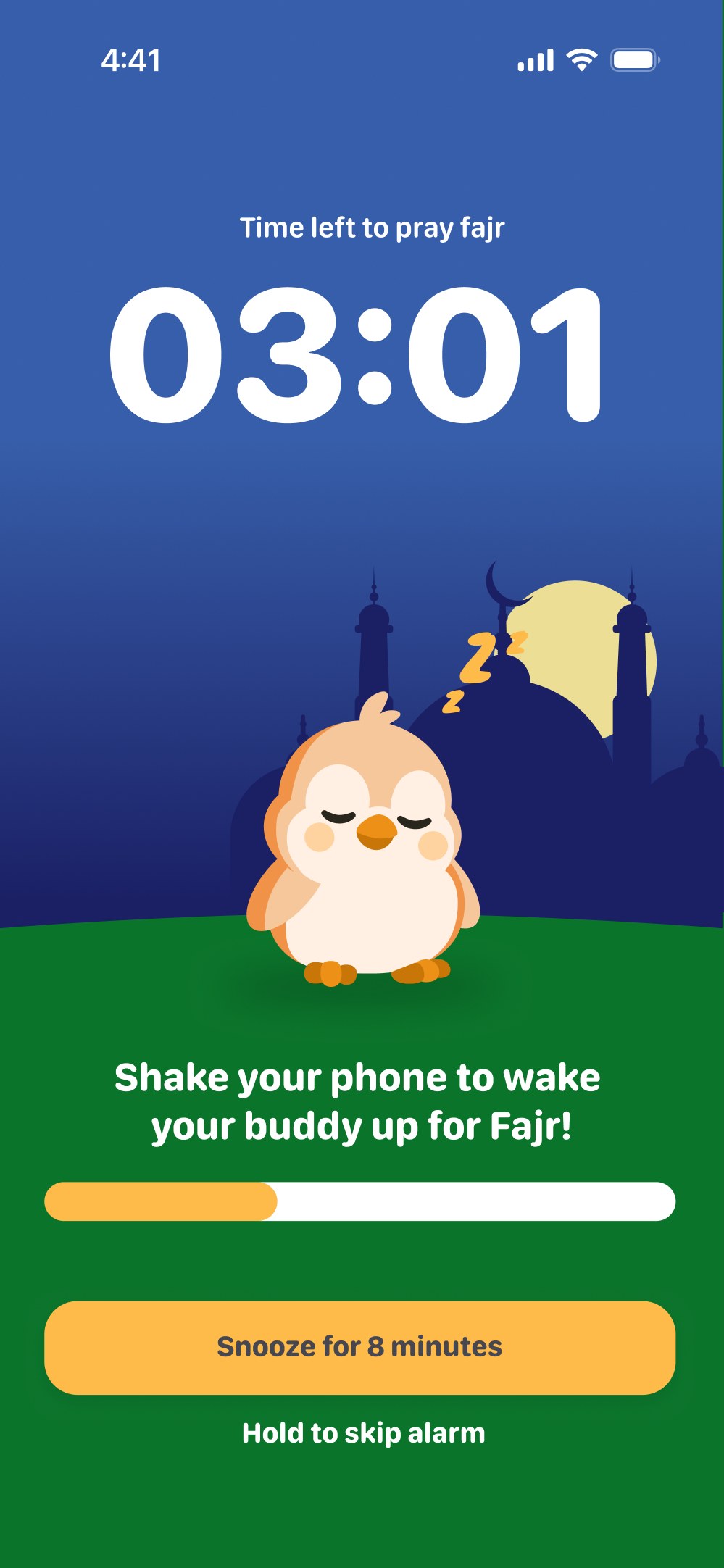
Most missed Fajrs are not people who never heard the alarm. They are people who switched it off and have no memory of doing it. A single tap is something you can do while still asleep. Pick an alarm that needs a deliberate action: solving something, walking somewhere, or shaking the phone until a bar fills. Anything that needs your brain properly awake will do.
Also be careful with snooze. One short snooze is fine for some people. Five snoozes that run past sunrise are not.
8. Put it out of reach, and test it on silent
If the alarm is next to your pillow, it is easy to silence without sitting up. Put it on the other side of the room so you have to stand. Once you are standing, you have done the hardest part.
Then check the boring details. Is the volume up? Does it ring when the phone is on silent, in a Focus mode, or locked? Does it still ring if the app was closed? Test it once during the day so you are not finding out at 5am. A second backup alarm, a few minutes later, costs nothing.
When it rings
9. Get up on the first ring and untie the three knots
The Prophet (peace be upon him) described Shaytan tying three knots at the back of a sleeper's head. When the person wakes and remembers Allah, one knot comes undone. When they make wudu, the second comes undone. When they pray, the last one does, and they start the day energetic and in good spirits (Sahih al-Bukhari 1142, Sahih Muslim 776).
That is also a very good wake-up routine. Do not lie there negotiating. As soon as the alarm goes, say the dua for waking, put your feet on the floor and head for wudu.
الْحَمْدُ لِلَّهِ الَّذِي أَحْيَانَا بَعْدَ مَا أَمَاتَنَا وَإِلَيْهِ النُّشُورُ
Alhamdu lillahil-ladhi ahyana ba'da ma amatana wa ilayhin-nushur.
All praise is for Allah, who gave us life after taking it from us, and to Him is the return.
Sahih al-Bukhari 6312
10. Use light and cold water
Turn on a bright light straight away. Light is one of the strongest signals to your body that the night is over. Then let the cold water of wudu finish the job. If you are still groggy, splash your face a second time before you start.
During the day
11. Find a Fajr buddy
Accountability works. Agree with a sibling, spouse, friend or your local masjid group to message each other after Fajr. A quick "up?" in a group chat at Fajr time is surprisingly hard to ignore, and praying Fajr in congregation at the masjid, when you can, adds even more reason to be up on time.
12. Nap at midday and track your streak
If your nights are short, a 20 to 30 minute nap in the early afternoon helps you catch up without ruining the next night's sleep. The midday rest, qaylulah, was a regular habit of the Companions.
Then keep score. Mark each Fajr you pray on time on a calendar, in a notes app or in an app built for it. A visible streak gives you something to protect on the mornings when motivation is low, and a miss becomes something you notice and fix rather than quietly forget.
Short summer nights in the UK
In a UK summer the gap between Isha and Fajr can shrink to just a few hours, and in some places and calculation methods Fajr falls before 3am. Seven hours in one block is simply not possible for most people. A few things help:
- Split your sleep. Sleep straight after Isha, wake for Fajr, then sleep again until work or school if your schedule allows. Top up with a midday nap.
- Know which timetable you follow. Different calculation methods give quite different Fajr times at high latitudes. Use the same method as your local masjid so you are not waking earlier or later than you need to.
- Prepare everything the night before. Prayer mat out, clothes ready, light easy to reach. When you are running on less sleep, remove every small obstacle.
If you are unsure about how to handle prayer times where you live, ask a scholar or your local imam. This guide is about the practical side of getting up.
If you miss Fajr
Everyone does at some point. On one journey, the Prophet (peace be upon him) and his Companions slept through Fajr until the sun had risen, and they prayed it once they woke (Sahih Muslim 680). He also said that whoever sleeps through a prayer should pray it as soon as they remember (Sahih Muslim 684).
So pray it as soon as you wake, without drama. Then ask one honest question: what went wrong last night? Too late to bed, phone in hand, alarm within reach? Change that one thing and try again tonight. Consistency is built from many ordinary mornings, not one perfect one.
Questions people ask
How many hours of sleep do I need to wake up for Fajr?
Most adults need 7 to 9 hours. Count back from your Fajr time to find your bedtime. When the night is too short, as in a UK summer, split your sleep and nap during the day.
What should I say when I wake up for Fajr?
The dua for waking: Alhamdu lillahil-ladhi ahyana ba'da ma amatana wa ilayhin-nushur, meaning "All praise is for Allah, who gave us life after taking it from us, and to Him is the return" (Sahih al-Bukhari 6312).
What if I sleep through Fajr?
Pray it as soon as you wake up, then adjust one thing about the night before.
Why does my alarm not wake me up for Fajr?
Usually it is too easy to switch off half asleep, it is within reach, or the phone is on silent or a Focus mode. Move it across the room, use an alarm that needs a deliberate action to stop, and test it on silent before relying on it.

Make tomorrow's Fajr the easy option.
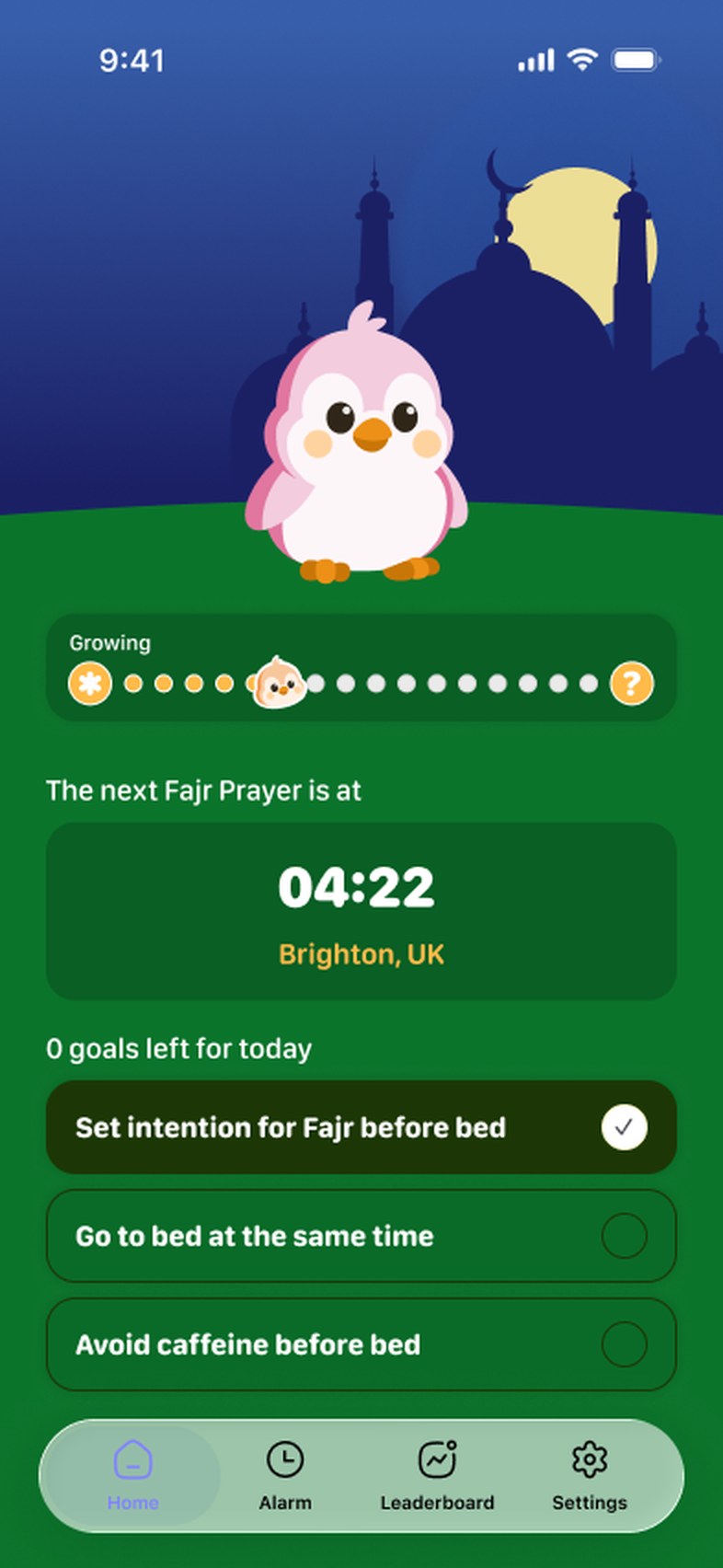
FajrBuddy rings through a locked phone, only stops when you shake it awake, and gives you a buddy that grows every morning you show up.
Download on iOSFor iPhone. Cancel any time.